

Stable Cell Line Construction
The CHO‑K1 Q host and its accompanying vector are of well‑defined origin and fully licensed, derived from wild‑type CHO‑K1 cells maintained at the European Collection of Cell Cultures (ECACC). The expression vector is pKS001, which employs glutamine synthetase (GS) as a selection marker under methionine sulfoximine (MSX) selection pressure. Electroporation is used, achieving transfection efficiencies of 90% or higher. We possess extensive expertise in signal peptide optimization, selection marker design, and codon optimization.
The CHO‑K1 Q host and its accompanying vector are of well‑defined origin and fully licensed, derived from wild‑type CHO‑K1 cells maintained at the European Collection of Cell Cultures (ECACC). The expression vector is pKS001, which employs glutamine synthetase (GS) as a selection marker under methionine sulfoximine (MSX) selection pressure. Electroporation is used, achieving transfection efficiencies of 90% or higher. The team possesses extensive expertise in signal peptide optimization, selection marker design, and codon optimization.
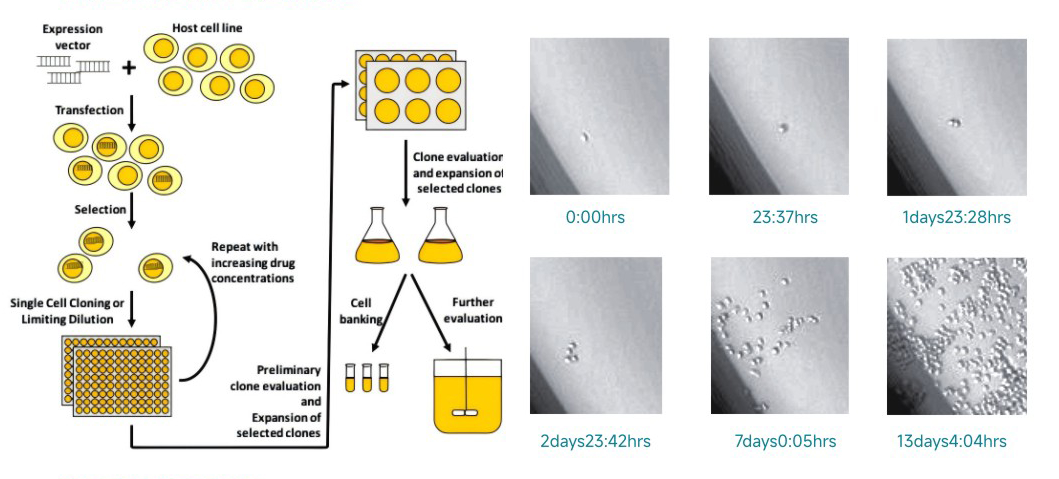
The Minipool screening method, combined with limiting dilution, was employed at a density of 0.4 cells per well, and single‑clone imaging was performed using dedicated single‑clone capture instruments (such as CSI, Cell Metric CLD, Nyone, etc.) to monitor the growth of individual clones. This approach fully complies with both Chinese and U.S. regulatory submission requirements.
From constructing the DNA plasmid to obtaining a stably transfected cell line with high expression, the entire process takes 4–6 months, while simultaneously meeting the requirements for growth, expression stability, and genetic stability of the PDL60 cell line.
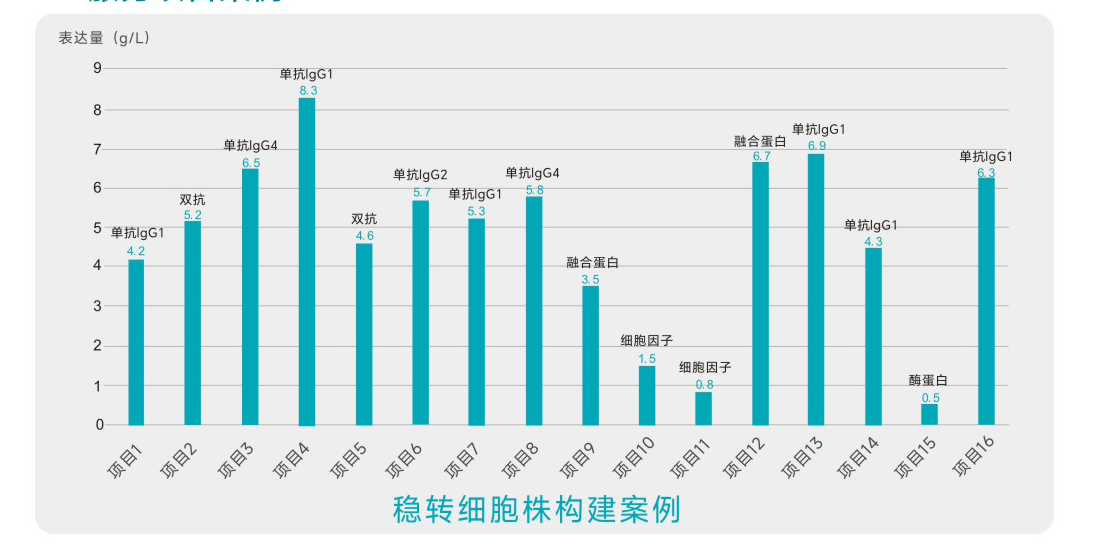
The expression levels of antibodies, bispecific antibodies, and fusion proteins in monoclonal cell lines typically range from 3.0 to 8.0 g/L, with good consistency across shake flasks, 3-L bioreactors, and 200-L bioreactors.
Stable Cell Line Construction Workflow
Service Cases
Service Content
Stage | Project | Content |
1 | 4-molecule assembly* | Sequence analysis, signal peptide design, gene synthesis and expression vector construction, and plasmid preparation for transfection. |
Two-molecule time-resolved assessment and preparation of HTRF standards | Transient expression is performed using the constructed plasmid to assess expression levels; following purification, SEC and CE analyses are conducted for use as protein assay standards. | |
Establishment and screening of two Minipools* | Perform two rounds of transfection, totaling 2–4 transfections; for each round, seed 10 wells in a 96-well plate. Conduct pressure‑based selection of cell populations, assess expression levels, and evaluate protein quality. | |
| Top Minipool performs material production (optional) | A 3-L or 50-L bioreactor is provided for cultivating Mininpool at its highest expression level. The harvested sample is subjected to purification, and protein quality is assessed using parameters such as SEC‑HPLC, nrCE‑SDS, and rCE‑SDS. Acceptance criteria are: SEC‑HPLC ≥ 95% and endotoxin ≤ 0.5 EU/mg. |
| Monoclonal screening | Based on titer assays and imaging data, approximately 40 monoclonal clones were screened for fed-batch cultivation. The three best-performing clones were selected to confirm the accuracy of their product sequences, and a preliminary fed-batch process for shake-flask scale-up was established. |
2 | Establishment of a Primary Cell Bank | Top 3 clones: Establish 25 original cell banks for each clone; freeze‑store 4–6 vials of all other cell lines. Upon thawing, verify the consistency of the original cell banks and perform sterility and mycoplasma testing. |
| Cell Line Stability Assay | Cell line stability studies compliant with Chinese and U.S. IND submission requirements: Conduct cell line stability assessments spanning at least 60 passage levels, including both pressurized subculturing and post‑PDL30 depressurized subculturing. Perform fed‑batch experiments at PCB, PDL15 (MCB/mMCB), PDL30 (WCB/mWCB), PDL45, and PDL60, evaluating both cell growth stability and product expression stability (acceptance criteria: no more than a 30% reduction in expression levels and no significant changes in product quality). |
3 | English Report (Optional) | English versions of the cell line construction report, the original cell bank establishment report, and the stability report. |
4 | Top 3 Clone Reactor Evaluations (Optional) | Evaluate the performance of different clones in 3–15 L bioreactors using existing platform processes. |
5 | Preparation of Application Materials (Optional) | Preparation of the aforementioned submission documents in CTD format. |
Service Description
Note: If a diagnostic‑reagent customer requires stable cell line construction services, the cost for generating a bulk pool—based on the provided amino acid sequence—ranges from RMB 200,000 to 250,000. Delivery timelines and yields will be confirmed according to the customer’s expression‑level requirements; typically, Xichang Bio can ensure that a single clone achieves an expression level of at least 4 g/L.
Delivery Materials
Host Cell Validation Documentation
Host Cell Traceability Documentation (e.g., purchase contracts, invoices, host cell origin reports)
Cell Line Construction Report
Description of the processes, including vector construction, transfection, cell pool screening, single‑clone cell line selection, and, where applicable, Top3 clone reactor evaluation, along with the corresponding experimental results.
Establishment of the Master Cell Bank and Stability Report
Includes a description of the procedures for establishing the master cell bank and conducting cell line stability studies, along with the experimental results.
Product Delivery
During the cell line development process, all minipools, monoclonal cell lines, and the master cell bank that have been cryopreserved—along with, where applicable to protein expression and production, the required protein samples—are included.
Documentary materials
Subscription Information
Subscribe to receive updates from Xichang News.


Shanghai Constream biotechnology Co., Ltd
Phone:021-59255902
Address: Building 2, Floors 2–3, Lane 10688, Beiqing Road, Qingpu District, Shanghai


WeChat Official Account
Copyright © 2026 Shanghai Constream biotechnology Co., Ltd.