

Hybridoma Screening Platform
Hybridoma technology is an important method for producing monoclonal antibodies. Based on cell fusion, it involves fusing B lymphocytes from immunized animals with myeloma cells, followed by selection using HAT medium and specific screening, and subcloning to obtain monoclonal antibody‑producing cell lines that secrete antibodies capable of specifically recognizing the target antigen. These cell lines are then cultured in vivo or in vitro and subjected to affinity purification to yield the desired monoclonal antibodies.
Hybridoma technology is an important method for producing monoclonal antibodies. Based on cell fusion, it involves fusing B lymphocytes from immunized animals with myeloma cells, followed by selection using HAT medium and specific screening, and subcloning to obtain monoclonal antibody‑producing cell lines that secrete antibodies capable of specifically recognizing the target antigen. These cell lines are then cultured in vivo or in vitro and subjected to affinity purification to yield the desired monoclonal antibodies.
Preparation process
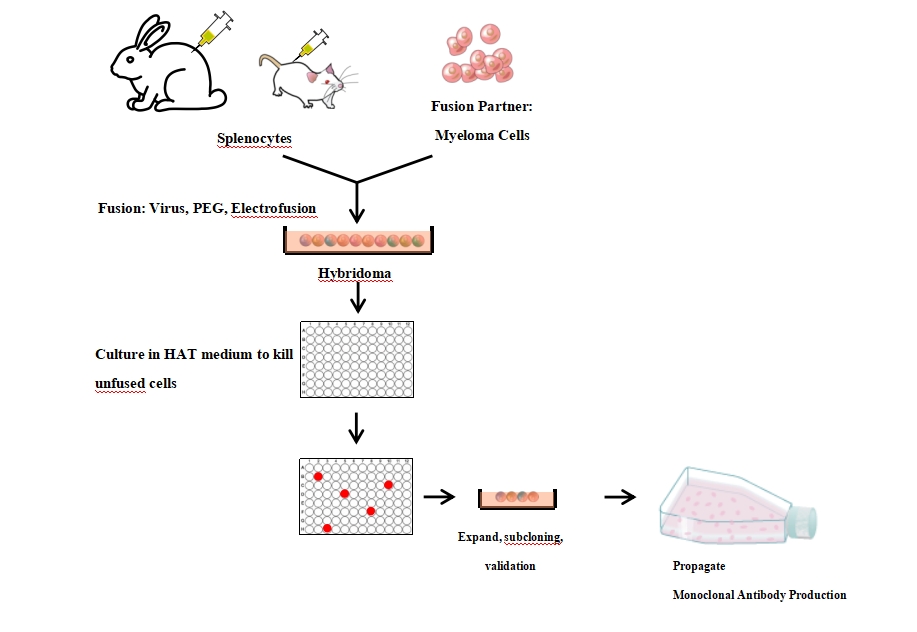
Preparation principle
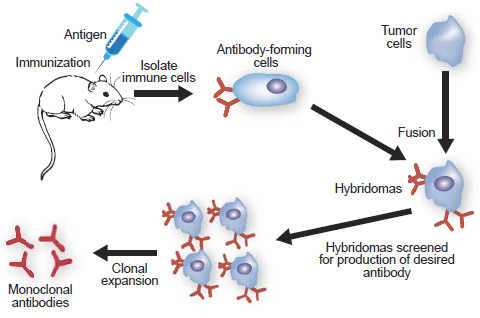
- B cells can secrete antibodies, and a single B cell clone produces a single type of antibody.
- B cells are primary cells that cannot be passaged indefinitely in vitro.
Myeloma cells are a continuously cultured tumor cell line that also originates from B cells, but they do not secrete antibodies themselves. Myeloma cells exhibit an HGPRT enzyme deficiency and cannot survive in HAT medium.
Service Content
Hybridoma screening
Service Items | Content | Cycle | Delivery |
Antigen preparation | Antigen design and expression validation, large-scale expression | 4 - 8 weeks | Antigen Design and Validation Report, with antigen expression tailored to specific requirements. |
Animal immunization | Antigen activity assay (optional), mouse immunization, titer determination | 8–10 weeks | Mouse immunization protocol and titer assay report |
Fusion, screening, and subcloning | Cell fusion, fusion assay, subcloning, and cryopreservation | 6 - 8 weeks | Antibody fusion and subcloning assay report, cryopreserved cell line |
Antibody Production, Purification, and Activity Assay | Serum-free antibody cultivation, antibody purification, and antibody activity assay | 2 - 4 weeks | Purified antibody, activity assay report |
Serum-Free Culture and Adaptation Techniques for Hybridoma Cells
Service Items | Content | Cycle | Delivery |
Serum-free culture and purification of antibodies | Serum-free antibody cultivation, antibody purification and purity analysis, and antibody activity assay (optional) | 2 - 4 weeks | Purified antibody, antibody purity assay report, and antibody activity assay report (optional) |
Serum-free adaptation of hybridoma cells | Direct adaptation of hybridoma cells, gradient adaptation of hybridoma cells, and serum-free expression and purification of adapted cells (optional) | 4 - 8 weeks | Cell adaptation report, cryopreserved cells (already adapted), purified antibodies (optional) |
Hybridoma antibody sequencing technology
Service Items | Content | Cycle | Delivery |
Hybridoma Cell Sequencing | Total RNA extraction from hybridoma cells, 5′-RACE cDNA synthesis, amplification of antibody VH/VL genes, TA cloning and sequencing, and data analysis. | 1 week | Sequencing experimental report, antibody sequences, and vectors containing antibody sequences |
Service Cases
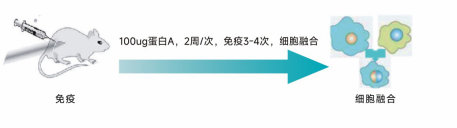
Immunization schedule
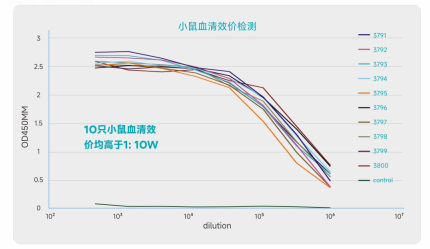
Potency assay
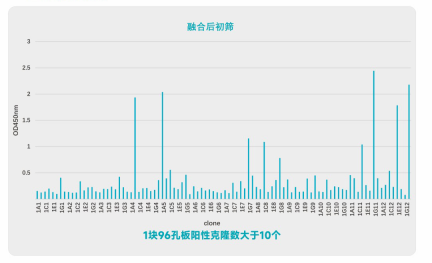
Fusion Detection
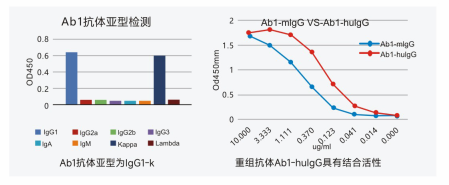
Antibody Subclasses & Recombinant Antibody Expression Identification
Documentary materials
Subscription Information
Subscribe to receive updates from Xichang News.


Shanghai Constream biotechnology Co., Ltd
Phone:021-59255902
Address: Building 2, Floors 2–3, Lane 10688, Beiqing Road, Qingpu District, Shanghai


WeChat Official Account
Copyright © 2026 Shanghai Constream biotechnology Co., Ltd.