
27
2025
-
03
“Targeting” the Lead: The Next PD‑1? Exploring the SOX17 Target
作者:
The immune system serves as the body’s primary defense against tumors; however, cancer cells often employ “immune evasion” mechanisms to disguise themselves and evade recognition and attack by immune cells. Although immune checkpoint therapies, exemplified by PD‑1/PD‑L1 inhibitors, have achieved remarkable progress in advanced cancers, their efficacy remains limited for early-stage tumors, such as colorectal cancer.
I. Cancer Immune Evasion: A Biological Puzzle in a “Cat-and-Mouse Game”
The immune system serves as the body’s primary defense against tumors; however, cancer cells often employ “immune evasion” mechanisms to disguise themselves and evade recognition and attack by immune cells. Although immune checkpoint therapies—particularly those targeting PD‑1/PD‑L1—have achieved remarkable success in advanced cancers, their efficacy remains limited in early-stage malignancies, such as colorectal cancer. Scientists have long sought to understand how tumors manage to “blind” the immune system even at an early stage. A study published in Nature has unveiled a key answer: the transcription factor SOX17, which has been shown to be a central “master regulator” of immune evasion in early‑stage colorectal cancer, offering a fresh perspective for cancer immunotherapy.
II. SOX17: A Versatile Player from Embryonic Development to Cancer
SOX17 belongs to the SOX (SRY‑related HMG‑box) transcription factor family and plays a critical role in embryonic development, angiogenesis, and organogenesis. Previous studies have shown that SOX17 is abnormally overexpressed in various solid tumors, such as hepatocellular carcinoma and gastric cancer; however, its functions within the tumor immune microenvironment remain unclear.
Investigational Drugs and Their Classifications:
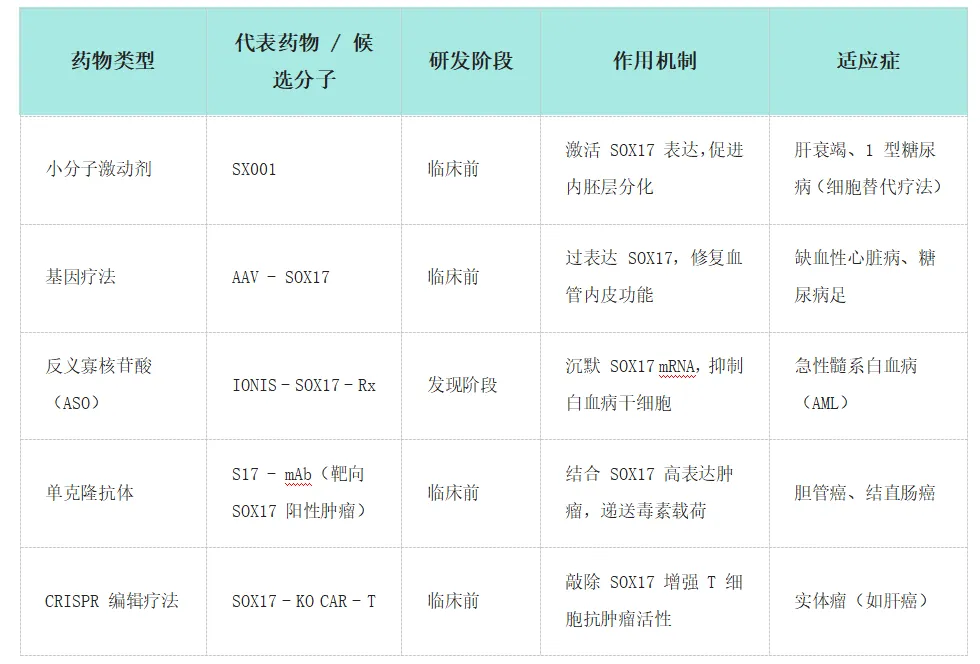
III. The Critical Role of the SOX17-Mediated Immune Evasion Mechanism in the Early Progression of Colorectal Cancer
(1) Tumor-Specific Induction of SOX17 and Functional Validation
1. Using an orthotopic xenograft model of colorectal cancer organoids, we found that the in vivo microenvironment drives SOX17 expression.
·Transcriptomic and chromatin accessibility analyses reveal that SOX17 is specifically upregulated in in vivo tumors but remains unexpressed in in vitro–cultured organoids.
·Immunohistochemistry confirmed that SOX17 is nuclear-positive in both xenografted tumors and spontaneous Apc-null adenomas, whereas it is not expressed in normal intestinal epithelium.
·Mechanistically, intrinsic immune pressure within the tumor (e.g., T cells) is not a prerequisite for SOX17 induction, suggesting that tumor cells autonomously respond to microenvironmental signals that drive its expression.

(Image from the references)
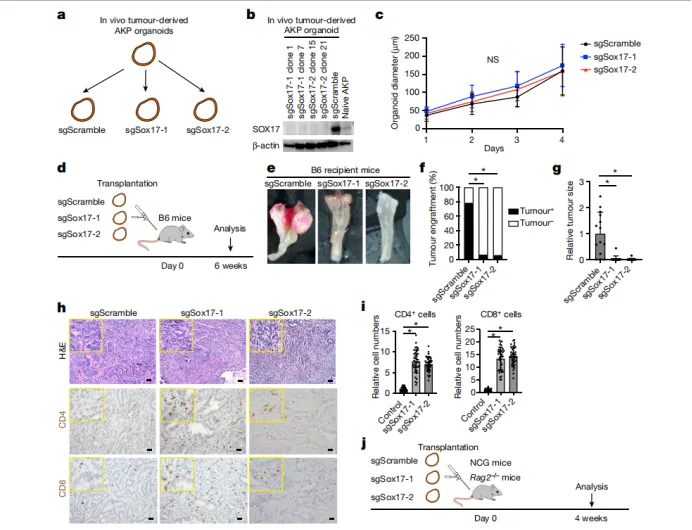
2. SOX17 deficiency leads to immune-dependent growth inhibition.
· CRISPR‑knockout SOX17 AKP organoids exhibit normal in vitro proliferation, but following orthotopic transplantation into immunocompetent mice, their tumorigenicity is reduced to 6% (versus 80% in the control group).
·Immunodeficient mice (NCG/Rag2) - In /⁻), the loss of SOX17 does not affect tumorigenesis, indicating that its function is dependent on immune evasion.
(Image from the references)
(II) Molecular Mechanisms by Which SOX17 Regulates the Immune Microenvironment
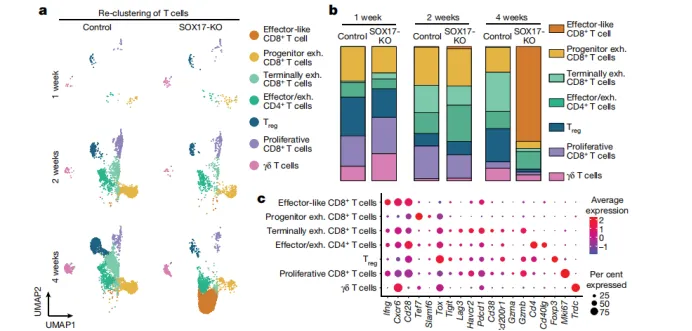
1. Inhibition of the IFNγ signaling pathway:
·Cellular sequencing revealed that tumors lacking SOX17 exhibited a significantly higher proportion of effector CD8⁺ T cells (IFNγ⁺TNF⁺), whereas the control group was dominated by exhausted T cells.
(Image from the references)
· SOX17 directly binds to the Ifngr1 promoter (as confirmed by CUT&RUN), thereby suppressing IFNGR1 expression, which in turn leads to reduced MHC-I expression and decreased secretion of CXCL10.
·Neutralizing antibodies against IFNγ or knockout of IFNGR1 can reverse the immune clearance of SOX17-deficient tumors.
2. Fetal Gut Program and Tumor Heterogeneity
·SOX17 activates fetal intestinal epithelial gene signatures and promotes the differentiation of LGR5⁺ tumor stem cells into LGR5⁻ cells; the latter exhibit reduced MHC‑I expression, conferring an immune evasion advantage.
·In vivo lineage tracing demonstrates that SOX17 deficiency increases the proportion of LGR5⁺ cells. 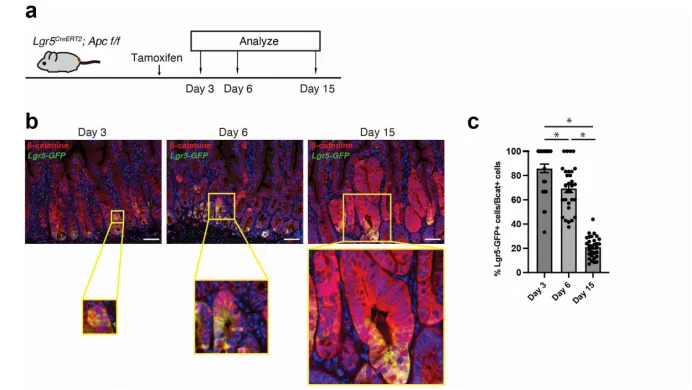
(Image from the references)
In short, SOX17 acts like a “cloak of invisibility” for cancer cells, enabling them to evade immune surveillance through two distinct mechanisms:
·Deactivation of the alarm system: Suppressing the interferon‑γ receptor prevents immune cells from recognizing cancer cells (akin to disabling a fire alarm);
·Camouflaging as normal cells: activating fetal‑stage intestinal developmental programs to allow cancer cells to blend into the normal cell population;
IV. Clinical Relevance and Therapeutic Implications
1. Human sample validation:
·All 19 adenomas and pT1-stage colorectal cancers exhibited high SOX17 expression, which was negatively correlated with CD8⁺ T-cell infiltration.
·Clinical significance: In the future, detecting SOX17 in stool or blood may enable earlier identification of precancerous lesions.
2. Potential for Targeted Intervention
·Inducible shRNA-mediated knockdown of SOX17 inhibits the growth of established tumors.
·Therapeutic outlook: SOX17 inhibitors currently under development may enhance the efficacy of existing PD-1 inhibitors.
Scientists say, “SOX17 acts like an ‘invisible switch’ for cancer cells, and our findings provide a critical target for early intervention. In the future, genetic testing could help identify high-risk individuals, allowing us to block this pathway before cancer develops.” — Professor Omer H. Yilmaz
References: Goto N, Westcott PMK, Goto S, Imada S, Taylor MS, Eng G, Braverman J, Deshpande V, Jacks T, Agudo J, Yilmaz ÖH. SOX17 enables immune evasion of early colorectal adenomas and cancers. Nature. 2024 Mar;627(8004):636-645. doi: 10.1038/s41586-024-07135-3. Epub 2024 Feb 28. PMID: 38418875.
Note: This article is reposted for sharing purposes only and is not intended for commercial use. If there are any copyright infringements, please contact us for removal.
Keywords:
Reference drug | Anti-drug antibodies | Instrument | Reagent
More News

Subscription Information
Subscribe to receive updates from Xichang News.


Shanghai Constream biotechnology Co., Ltd
Phone:021-59255902
Address: Building 2, Floors 2–3, Lane 10688, Beiqing Road, Qingpu District, Shanghai


WeChat Official Account
Copyright © 2026 Shanghai Constream biotechnology Co., Ltd.